A sump pump is failing when it stops moving water out of the pit, and the warning signs are consistent: a motor that hums without pumping, a pump that runs nonstop, grinding noises, rust in the pit, and any pump past its tenth birthday.
Most failures do not arrive out of nowhere. They show up weeks ahead as small changes in sound and cycling.
At Buckeye Basement Solutions, we pull dead pumps out of Central Ohio basements every spring, and the same short list of causes comes up again and again.
This guide covers the signs worth watching, what causes each one, a five-minute test you can run today, and how to decide between repair and replacement.
10 Signs Your Sump Pump Is Failing
The clearest signs of sump pump failure fall into four groups: no power, no water movement, abnormal run time, and abnormal noise. Here is what each symptom usually means.
1. The Pump Does Not Turn On at All
Water is rising in the pit, and the pump stays silent. Before assuming the motor is dead, check the plug, the outlet, and the breaker. A silent pump is more often a de-energized pump than a burned-out one.
2. The Motor Hums but No Water Moves
The pump sounds like it is working and the water level does not drop. This points to a blockage, a jammed impeller, or an air lock, not a failed motor. It is the single most misdiagnosed symptom we see.
3. The Pump Runs Constantly
A pump that never shuts off during dry weather is fighting something. Common causes are a stuck float, a failed check valve letting water drain back into the pit, or a pump that is undersized for the volume coming in.
4. The Pump Cycles On and Off Every Few Seconds
Short cycling wears a motor out fast. In most cases, the pit is too small for the pump, the float range is set too tight, or water is returning through a bad check valve.
5. Grinding, Rattling, or Screeching Noises
Grinding usually means a damaged impeller or debris in the housing. Rattling often means the discharge pipe is loose or the pump is knocking against the pit wall. Neither noise resolves itself.
6. Rust, Corrosion, or Orange Sludge in the Pit
Rust on the housing points to age and standing moisture. An orange or rust-colored gel is different: that is iron bacteria, and it clogs inlet screens, floats, and check valves. Central Ohio has plenty of it.
7. Water on the Floor While the Pump Is Running
If the pump runs and the basement still takes on water, the problem is likely downstream of the pump. Check the discharge line for a clog, a disconnected joint, or a frozen section.
It can also mean water is entering somewhere the pit does not serve, which is a different problem covered in our post on water leaking into a basement after heavy rain.
8. The Pump Vibrates Hard or Has Shifted in the Pit
Hard vibration bends the impeller shaft over time. A pump that has walked out of position can also snag its own float cord, which turns a healthy pump into a silent one.
9. The Breaker or GFCI Outlet Keeps Tripping
Sump pumps belong on a GFCI outlet, and moisture can trip one quietly. A tripped GFCI can leave a pump switched off for weeks without anyone noticing.
Repeat trips point to a failing motor winding or a wiring fault.
10. The Pump Is More Than 10 Years Old
FEMA advises homeowners to assess the sump pump once a year and to replace a pump that is more than 10 years old, that never seems to run, or that leaves deep puddles around the home during rain.
Most submersible units in Ohio service give out somewhere between years seven and ten.
What Actually Causes Sump Pump Failure
Power loss causes more sump pump failures than motor burnout does. During storm season, the majority of dead pumps we find are not broken at all: they are unplugged, tripped, or riding out an outage.
If you want a refresher on how the float switch and discharge line actually move water out, that mechanical walkthrough is a good starting point. Below are the failure modes in the order we encounter them.
Power Loss and Tripped GFCI Outlets
Storms take out the grid at exactly the moment the pump is needed most. A tripped GFCI is worse than an outage because nothing tells you it happened.
An audible pit alarm or a Wi-Fi monitor solves this. Removing the GFCI does not.
Float Switch Snags
The float can hang on the pit wall, the power cord, or the pump body. Tethered floats need room to swing. Vertical and electronic switches take up less space and snag less often.
Clogged Pit, Inlet Screen, or Impeller
Gravel, silt, drywall dust, and iron bacteria all end up in the pit. FEMA recommends cleaning the inlet screen more than once a year. A lid on the pit cuts debris dramatically.
Frozen or Blocked Discharge Line
This is the Ohio failure mode. Water left standing in an above-grade discharge line freezes into a plug in January, and the pump dead-heads against it. The fix is a freeze-relief fitting or a grade-level relief port, not simply burying the pipe deeper.
Air Lock From a Missing Weep Hole
Most manufacturers require a small air-relief hole in the discharge pipe between the pump and the check valve. Skip it, and the pump traps air, sounds completely normal, and moves no water. This is not an optional detail.
A Check Valve Installed Backward
Ohio plumbing code requires a full-flow check valve on the discharge. Installed backward, it blocks flow entirely. Failed, it lets water drain back into the pit and the pump short-cycles forever. Stacking two check valves creates its own problems.
A Pump or Pit That Is Too Small
Ohio plumbing code sets a floor of 18 inches in diameter and 24 inches deep for the pit. Anything tighter forces short cycling.
A pump sized below the inflow rate will run continuously and still lose ground during a heavy spring rain. Sizing is the part of a sump pump installation that gets skipped most often.
Symptom to Cause: A Quick Diagnostic Table
| What you notice | Most likely cause | Safe to check yourself | Stop and call a pro |
|---|---|---|---|
| Silent pump, rising water | No power, tripped GFCI or breaker | Plug, outlet, breaker panel | Breaker trips again after reset |
| Humming, no water movement | Air lock, clog, jammed impeller | Debris visible at the inlet screen | Weep hole is missing or pipe must be opened |
| Runs nonstop in dry weather | Stuck float, failed check valve | Float can swing freely | Check valve replacement, drain tile inspection |
| Cycles every few seconds | Pit too small, backflow | Water draining back after shutoff | Pit resizing, valve or pump replacement |
| Grinding or screeching | Damaged impeller, debris in housing | Unplug the pump, look for obvious debris | Any disassembly of the pump body |
| Water on the floor, pump running | Discharge clog, freeze, or disconnect | Exterior discharge outlet is flowing | Buried line, frozen line, or no visible outlet |
| Orange gel in the pit | Iron bacteria | Rinse the screen and lid | Recurring clogs, discolored seepage |
Anything involving standing water and electricity is where the self-diagnosis stops. Do not reach into a flooded pit that is still energized.
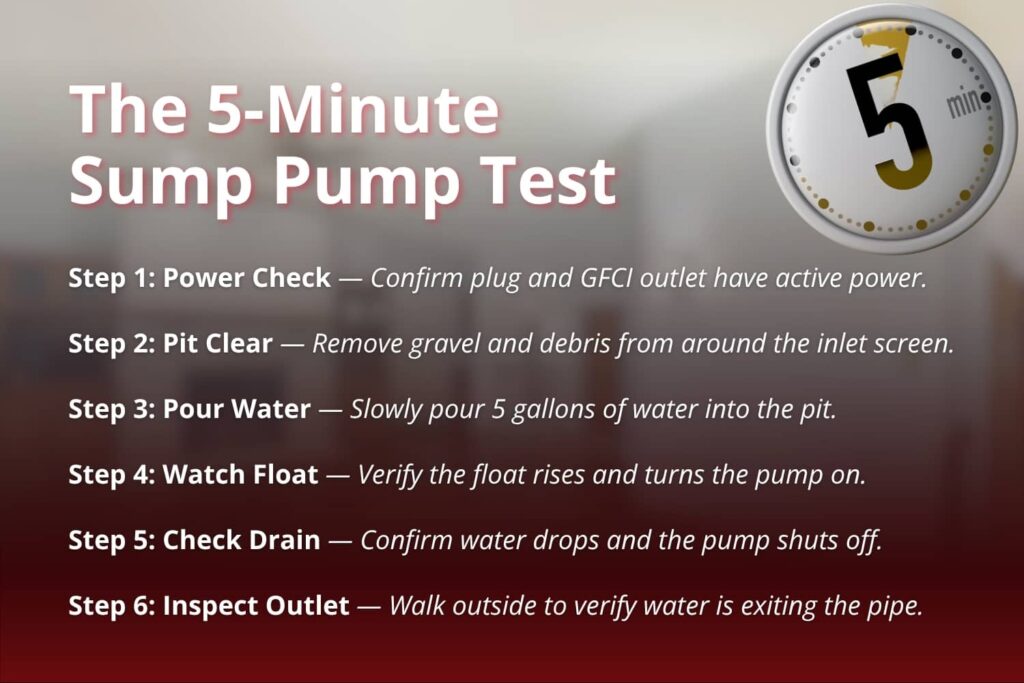
How to Test Your Sump Pump in Five Minutes
Run this test twice a year, in early spring and again in late fall.
- Confirm the pump is plugged in and the outlet has power.
- Look at the pit. Clear out gravel, silt, or debris around the inlet screen.
- Slowly pour five gallons of clean water into the pit.
- Watch the float rise. The pump should switch on before the water reaches the pit rim.
- Confirm the water level drops steadily and the pump shuts off on its own.
- Walk outside and confirm water is actually leaving the discharge outlet.
Step 6 is the one homeowners skip, and it is the one that catches frozen and disconnected lines. If the pump cycles correctly but nothing comes out of the pipe, the pump is fine and the line is not.
Where that pipe ends matters too, and there are real rules about where the discharge should send water once it leaves the pit.
Repair or Replace? How to Decide
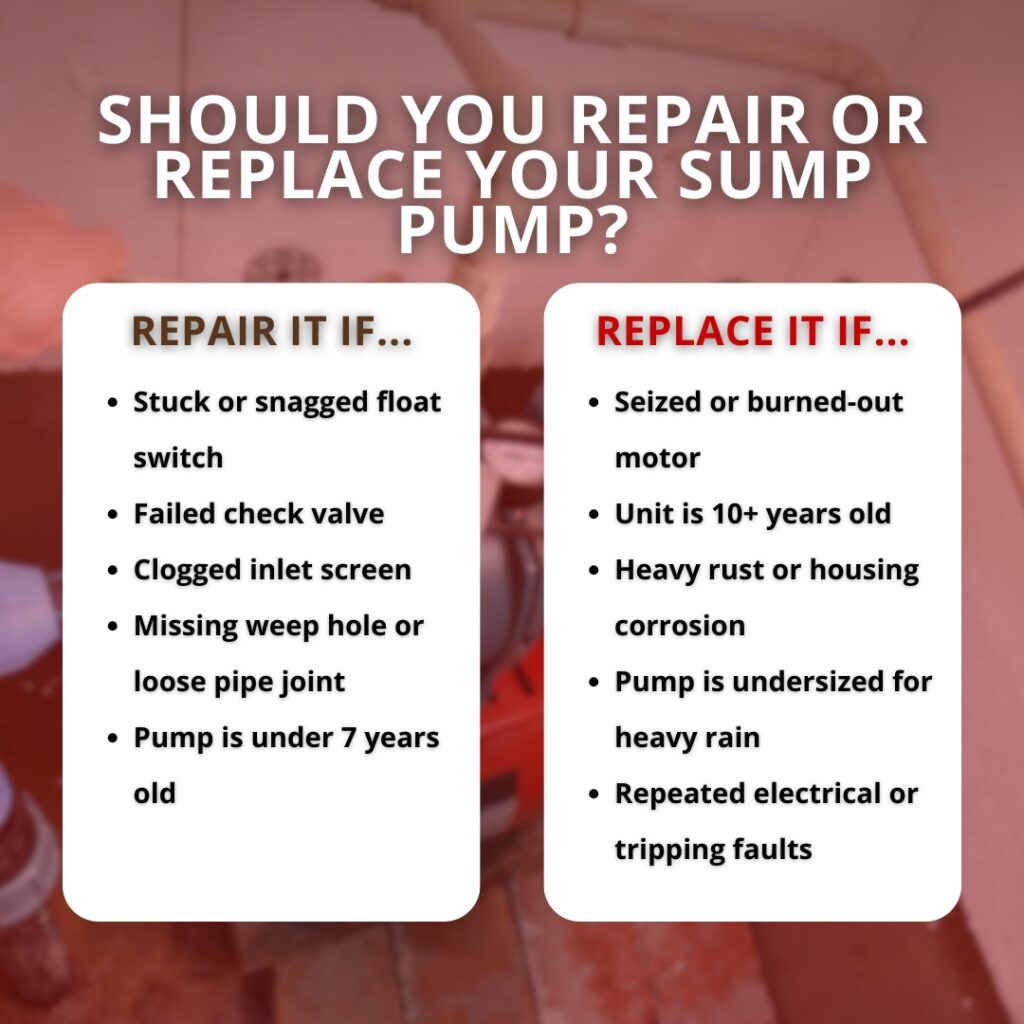
Repair when the pump itself is sound, and one part has failed. Replace when the motor is the problem or the unit is near the end of its service life.
Repair usually makes sense for: a snagged or failed float switch, a bad check valve, a clogged inlet screen, a loose discharge joint, a missing weep hole, or a wiring or outlet fault.
Replace when: the motor is seized or burned out, the pump is more than 10 years old, the housing is heavily corroded, the unit has already been repaired once, or the pump is undersized for what the basement takes on.
| Work | National range, 2026 cost guides |
|---|---|
| Float switch or check valve repair | $150 to $400 |
| Standard pump replacement | $650 to $1,200 |
| Replacement plus battery backup | $1,500 to $3,000 |
| New pit, pump, and discharge line | $2,500 and up |
One more piece of math homeowners miss: a single finished-basement water event routinely costs more than a new pump and a backup combined.
If your pump is nine years old and you are weighing $900 against waiting another season, that is the comparison to make.
Why Ohio Basements Are Hard on Sump Pumps
Central Ohio pumps work harder than pumps in most of the country, for three reasons.
Glacial-till clay. Clay soil absorbs water slowly and holds it against the foundation wall. That drives hydrostatic pressure at the cove joint where the wall meets the floor, so more water reaches the drain tile, and the pit runs more often. More run time is more wear.
Freeze and thaw. Repeated freezing widens existing cracks over the winter, which increases inflow in spring. The same cycle is what freezes an above-grade discharge line solid.
Spring rain on a high water table. March through May, the water table sits high and the pit refills faster than it drains. A pump that coped fine in August will struggle in April.
If your basement takes water only during heavy rain, our comparison of how a sump pump and a French drain divide the work explains why one system alone is sometimes not enough.
Local rules matter as well. In Hamilton County, for example, sump discharge must run at least 15 feet from any property line and may not discharge into a street, alley, parking lot, building sewer, or sanitary main.
Requirements vary by county, and a permit and inspection are often required. A homeowner-installed pump can fail inspection even when it works.
Backup Systems That Prevent the Next Failure
Since power loss is the leading cause of failure, redundancy solves more problems than a better primary pump does.
Battery backup pumps are the common choice. They run off a deep-cycle battery and take over when the primary loses power. Plan on replacing the battery every three to five years, and know your runtime.
Most Ohio outages clear in two to four hours, but storm damage can stretch past 24 hours, which is the window the battery has to cover.
Water-powered backups use municipal water pressure and need no electricity or battery. They are not an option on a well, and some jurisdictions restrict them over cross-connection concerns.
A pit alarm or Wi-Fi monitor is the cheapest upgrade on this list. It will not pump water, but it tells you the pump is off, which is exactly the failure a GFCI trip hides.
One caution: cutting the power cord, wiring a pump to a switch, or running it off an extension cord will generally void the manufacturer’s warranty.
Related Questions to Explore
What are the first signs a sump pump is about to fail?
Changes in sound and cycling come first. A pump that starts cycling more often than it used to, runs longer per cycle, or develops a new rattle is telling you something before it quits. Visible rust and a pit that stays full after rain are later-stage signs.
Why is my sump pump humming but not pumping water?
Because the water has nowhere to go or the impeller is not moving it. The three usual causes are an air lock from a missing weep hole, a clog at the inlet screen or in the impeller housing, and a blocked or frozen discharge line. The motor is usually fine.
How long do sump pumps last before they need replacing?
Most submersible pumps last seven to ten years in Ohio service. Pedestal pumps often run longer because the motor sits above the water. FEMA’s guidance is to replace any pump older than 10 years regardless of how it sounds.
How often should a sump pump run during heavy rain?
Cycling every few minutes during a hard rain is normal. Cycling every few seconds is not, and neither is running continuously for hours after the rain stops. Our post on what a sump pump actually does covers normal operation in more detail.
What happens if my sump pump fails while I am away?
Water rises to the pit rim, then across the floor. How fast depends on inflow. In a wet Central Ohio spring, an unattended failure can put several inches of water in a basement in under a day. A battery backup plus a monitor that texts you is the practical answer for anyone who travels.
Does homeowners insurance cover a sump pump failure?
Usually not by default. Standard policies commonly exclude water damage from sump pump failure and sewer backup unless a water-backup endorsement has been added. Check your policy before you need it, and note that a sump pump is a different system from a sewage ejector pump, with different coverage.
When to Call a Professional
Call someone when the diagnosis crosses into water, wiring, or the discharge line. Specifically:
- The breaker or GFCI trips again after you reset it.
- The pump hums and you cannot find the blockage at the inlet screen.
- Water is on the floor while the pump is running.
- The pit is smaller than 18 inches across, or the pump short-cycles no matter what you adjust.
- The discharge line is buried, frozen, or you cannot find where it terminates.
- Orange iron bacteria keeps returning after cleaning.
- The pump is past 10 years old, and you would rather not gamble on another spring.
We offer free inspections across the Greater Columbus area, including Dublin, Hilliard, Westerville, Pickerington, Lancaster, and Zanesville.
A basement inspection tells you whether you are looking at a pump problem or a drainage problem, and those two answers cost very different amounts.
We only suggest work that is needed, and we will beat any written competitor’s price.
Conclusion
- Sump pump failure gives warning. Sound, cycling frequency, and run time change before the pump quits.
- Power loss and clogs cause more failures than dead motors. Check the plug, the GFCI, the float, and the discharge outlet before assuming the worst.
- Age is a reason on its own. Past 10 years, replacement is the safer math than a repair.
If your pump is making a new noise or your basement took water this spring, we can tell you which it is. Schedule your free estimate, and we will look at the pump, the pit, and the discharge line together and give you a straight answer about what your home actually needs.
For sump pump repair and replacement in Columbus, that inspection is the place to start.