Most Columbus homeowners do not spend much time thinking about what is happening under their house. Even fewer spend time pondering the crawl space ventilation.
But your crawl space has a direct effect on your air quality, energy bills, floor stability, and the long-term health of your foundation. When the ventilation system down there stops working the way it should (or is missing entirely), the problems rarely stay contained.
This guide covers what failing crawl space ventilation actually looks like, why it happens in central Ohio homes, and what your real options are for fixing it.
Why Crawl Space Ventilation Matters
Research suggests that roughly 40% of the air circulating in your home’s first floor comes up from the crawl space or other lower levels, like basements. That means whatever is going on down there, moisture, mold spores, musty odors, is working its way into the air your family breathes every day.
Traditional vented crawl spaces were designed with the idea that outside air would flow in, circulate, and carry moisture out. It made sense in theory. In practice, especially in climates like central Ohio’s, it creates more problems than it solves.
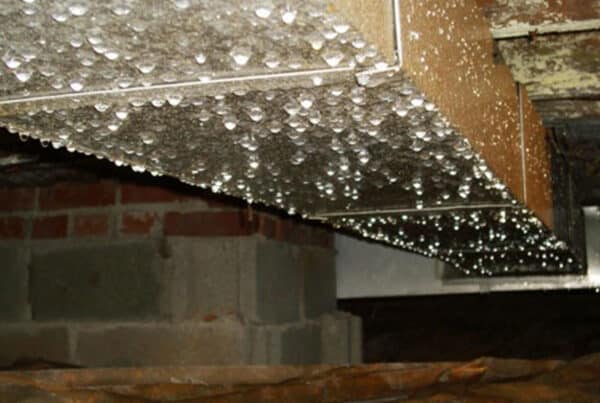
Warm, humid summer air enters through the vents and hits the cool, damp crawl space surfaces. That temperature difference causes condensation, and that moisture has nowhere to go.
Over time, that cycle does real damage.
What Causes Crawl Space Ventilation to Fail?
Ventilation does not fail all at once. It deteriorates gradually, and by the time most homeowners notice something is wrong, the underlying issues have already been developing for months or years.
Common causes in Columbus-area homes:
- Blocked or damaged vents from debris, pest nesting, or physical deterioration over time
- Inadequate vent placement or sizing that creates dead zones where air does not circulate
- High outdoor humidity pulls moisture in faster than passive venting can push it out, particularly during Ohio’s humid summers
- Missing or degraded vapor barrier on the crawl space floor, allowing ground moisture to evaporate directly into the space
- Settled or shifted foundation walls that have altered the original vent openings
- Pest intrusion through open vents that leads to nesting, blockages, and moisture retention
Ohio’s freeze-thaw cycles also play a role. Repeated expansion and contraction of soil and foundation materials around Columbus can compromise vent integrity over the years in ways that are easy to miss without a professional eye.
Signs Your Crawl Space Ventilation Is Failing
You may not be able to see into your crawl space easily, but your house will tell you something is wrong. Here are the warning signs to watch for:
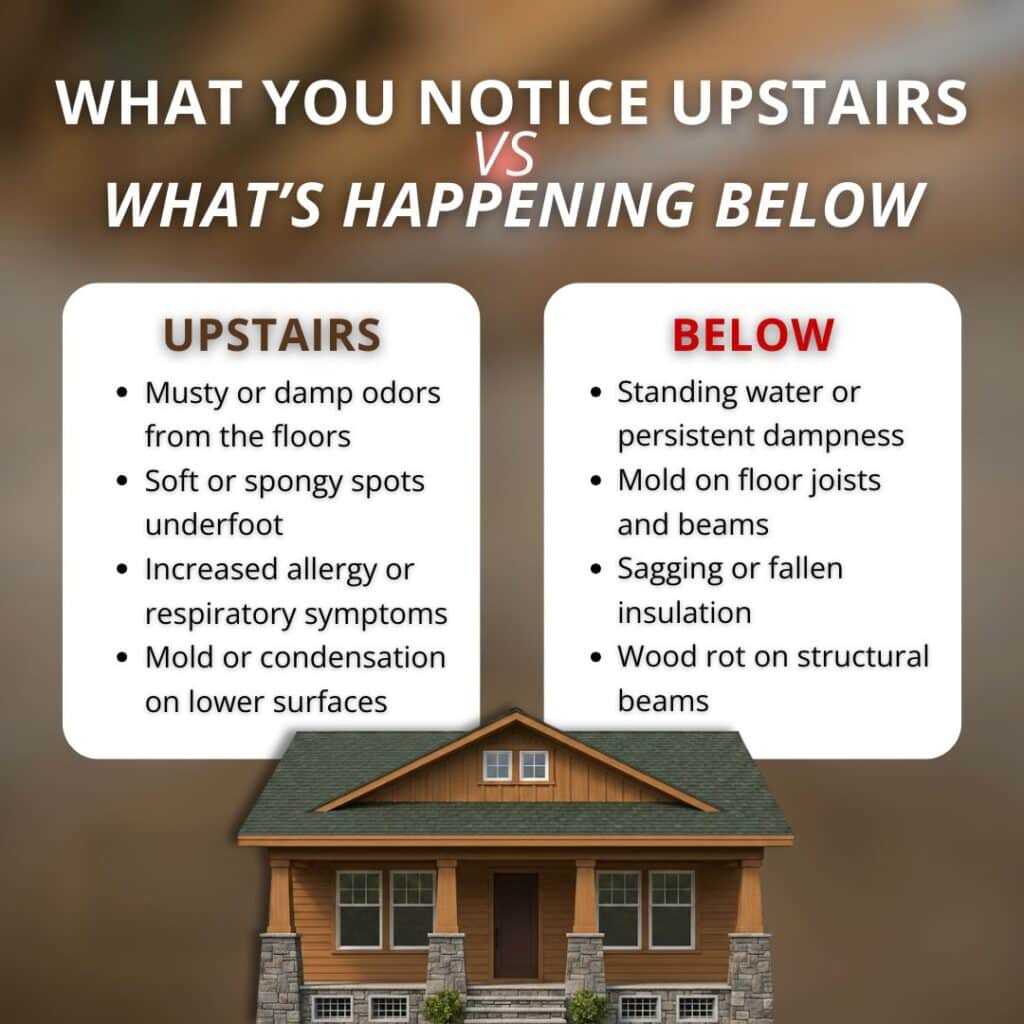
Above the crawl space (inside your home):
- Musty or damp odors that seem to come from the floors or the lower level of the home
- Floors that feel soft, spongy, or uneven underfoot
- Increased allergy or respiratory symptoms among household members
- Higher-than-normal energy bills, especially in summer
- Visible mold or condensation on basement walls or lower floor surfaces
In the crawl space itself:
- Standing water or persistent dampness on the ground
- Visible mold growth on floor joists, beams, or insulation
- Sagging, wet, or fallen insulation between the floor joists
- Rust on metal components such as HVAC equipment or ductwork
- Wood rot on structural beams or joists
- Evidence of pest activity, including droppings, nesting material, or damage
If you are seeing more than one of these at the same time, that is a sign the system has been failing for a while.
The Problem With Traditional Vented Crawl Spaces in Ohio
This is where it gets important to understand the science. Passive crawl space venting was the standard approach for decades. The idea was that outside air would dry out the space naturally. Building scientists have since shown that in mixed and humid climates, venting often makes moisture problems worse, not better.
During a Columbus summer, outdoor air can carry significant humidity. When that humid air flows into the cooler crawl space, it does not dry the space out. It deposits moisture onto every surface it touches, including your floor joists, insulation, and vapor barrier. Ohio sits squarely in a climate zone where this dynamic is well-documented.
The International Residential Code (IRC) now recognizes this reality. Section R408 provides an alternative to traditional venting that calls for a sealed, conditioned crawl space instead, acknowledging that passive vents are not always the right solution depending on local climate conditions.
This does not mean venting is always wrong. It means that for many Columbus homes, especially older ones built with minimal or poorly positioned vents, venting alone is insufficient, and the system needs to be reassessed.
Your Options When Ventilation Is Failing
When crawl space ventilation is not doing its job, there are a few paths forward depending on the severity of the problem and the current condition of the space.
Option 1: Repair and improve existing vents: If the vents are simply blocked, damaged, or improperly sized, addressing those issues directly may be a reasonable first step.
This works best when the space is otherwise in good condition and moisture levels are only mildly elevated.
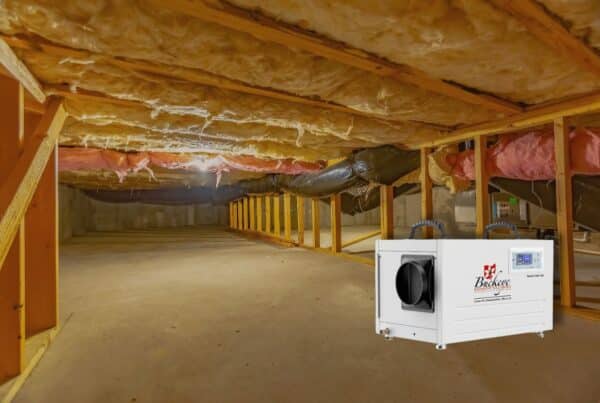
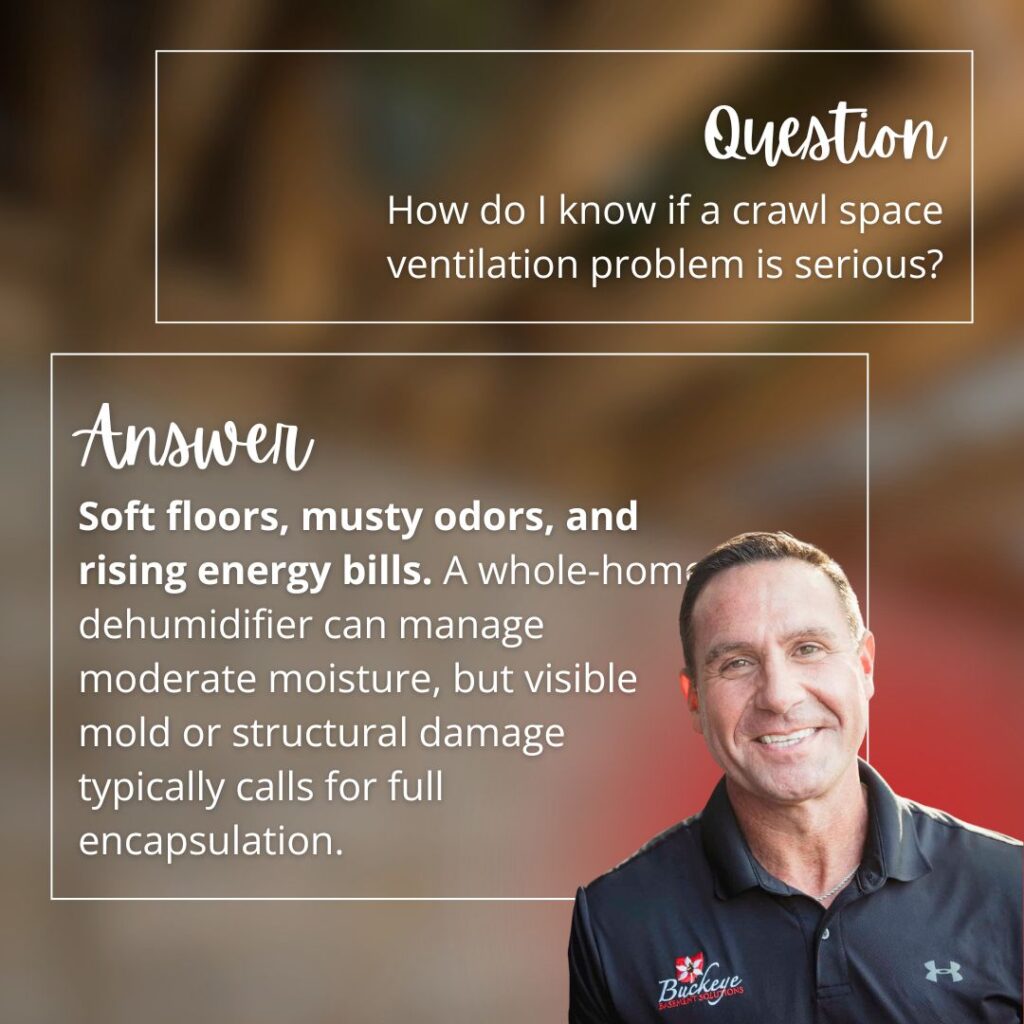
Option 2: Add mechanical ventilation or a dehumidifier: A crawl space dehumidifier actively pulls moisture out of the air rather than relying on passive airflow. This is a meaningful upgrade for spaces where humidity is elevated, but encapsulation is not yet warranted.
Pairing proper ventilation with a clean air dehumidifier system can significantly improve air quality throughout the home.
Option 3: Crawl space encapsulation: For crawl spaces with chronic moisture issues, visible mold, damaged insulation, or signs of structural deterioration, encapsulation is typically the most comprehensive and lasting solution.
The process involves sealing the crawl space walls and floor with a heavy-duty vapor barrier, eliminating the direct connection between the ground, outside air, and the rest of the home.
At Buckeye Basement Solutions, encapsulation uses a 20 MIL thick, cord-reinforced liner covering both the floor and walls. For spaces with standing water or drainage concerns, a drainage system beneath the liner directs water to a sump pump, keeping the area dry even in wet seasons.
| Solution | Best For | What It Addresses |
| Chronic moisture, mold, and rot risk | Mild moisture, minor damage | Blockages, sizing, placement |
| Dehumidifier system | Moderate humidity, no major damage | Active moisture control, air quality |
| Full encapsulation | Chronic moisture, mold, and rot risk | Moisture, air quality, structure, energy efficiency |
What Happens If You Ignore It?
Failing crawl space ventilation is not a problem that stabilizes on its own. Without intervention, the damage compounds.
Persistent moisture leads to mold growth on floor joists and structural beams. Wet wood is also a magnet for wood-destroying insects, including termites and carpenter ants. As beams and joists soften from rot or pest damage, floors above begin to sag and lose structural integrity. In more advanced cases, foundation walls can be affected as well.
Water and moisture issues in the crawl space are also closely tied to what happens in the basement. A crawl space that is consistently wet or poorly sealed adds hydrostatic pressure and humidity to adjacent areas, worsening seepage, wall cracks, and foundation stress.
Addressing the crawl space is often a necessary part of protecting the basement and foundation as a whole.
Other Related Questions
What is the difference between crawl space encapsulation and waterproofing?
Encapsulation focuses on sealing the crawl space from moisture and outside air using a vapor barrier system. Waterproofing addresses active water intrusion, which can involve drainage systems, sump pumps, and wall crack repair.
Can a failing crawl space affect the basement?
Yes. The two spaces are closely connected, and moisture problems in a crawl space often contribute to humidity, mold, and seepage issues in a connected basement. Treating one without evaluating the other can lead to incomplete results.
How does crawl space moisture affect floor joists and structural wood?
Persistent moisture causes wood rot in floor joists and support beams over time. Sagging or uneven floors are a common result. In serious cases, structural carpentry repairs or full joist sistering may be needed to restore the integrity of the floor system.
What role does a sump pump play in crawl space moisture control?
In encapsulated crawl spaces with a drainage system, a sump pump collects and expels water that accumulates beneath the vapor barrier liner. Without a functioning sump pump, even a properly encapsulated space can develop water problems during heavy rain or snowmelt events common in central Ohio.
When to Call a Professional
If you are noticing any of the warning signs listed in this post, it is worth having a professional team evaluate the space before deciding on a course of action. A crawl space that looks manageable from the access hatch often has more going on than is visible at first glance.
The same is true before buying a home. If you are purchasing a property in Columbus, Westerville, Dublin, Hilliard, Grove City, or the surrounding area with a crawl space foundation, a thorough inspection of that space should be part of your due diligence.
Problems found before closing are problems you can negotiate. Problems found after closing are yours to fix.
Conclusion
Your crawl space does a lot of quiet work to keep your home stable, dry, and healthy. When the ventilation system starts to fail, it rarely announces itself loudly. It shows up as a musty smell, a soft spot in the floor, a spike in your energy bill, or condensation that should not be there.
The good news is that crawl space ventilation problems are fixable, and addressing them early almost always costs less than waiting.
If you have questions about what is going on under your home, Buckeye Basement Solutions offers inspections and honest assessments across the Columbus metro area.