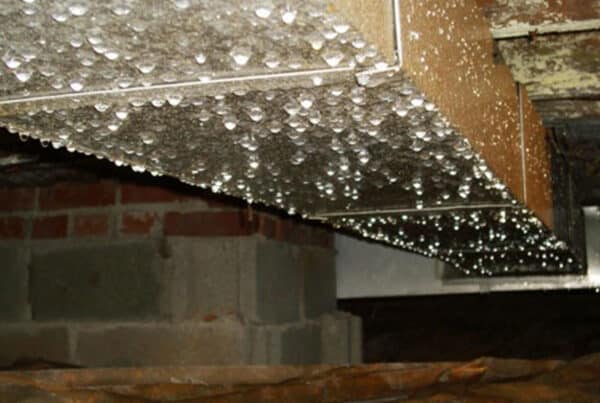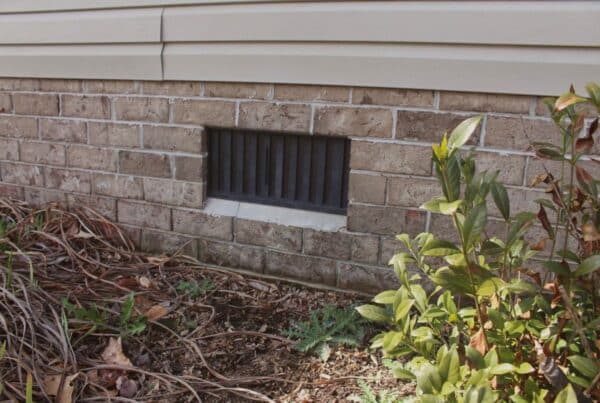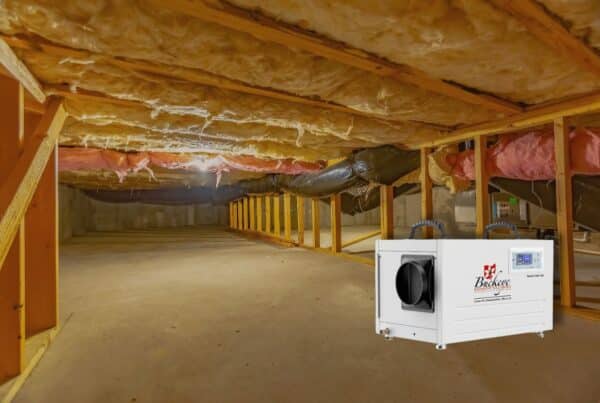
A musty crawl space smell is the smell of active mold growth, not simply dampness. That earthy odor is microbial volatile organic compounds, gases mold releases as it feeds on damp wood and dust.
If you can smell it, something under your house is wet enough to grow mold right now.
At Buckeye Basement Solutions, we inspect crawl spaces across Central Ohio, and the same pattern shows up every summer: humid outdoor air pours through open vents, condenses on cool framing, and the smell arrives in the living room a few weeks later.
This post covers what the odor means, the humidity numbers that decide whether mold grows, and what actually removes it.
What That Musty Smell Actually Is
Mold releases mVOCs as it digests organic material, and those gases are what your nose picks up.
The EPA is direct about it: because mVOCs often have strong or unpleasant odors, they can be the source of the moldy or musty smell, and a moldy odor suggests that mold is growing in the building and should be investigated.
Two things follow from that. First, the smell is evidence, not a nuisance. Second, there is no point treating the air.
The gases keep coming as long as the mold keeps eating, and the mold keeps eating as long as the wood stays damp.
Smell to Cause: What Your Nose Is Telling You
Not every crawl space odor is mold. Sorting the smell first saves a great deal of guessing.
| What it smells like | Most likely cause | What to do |
|---|---|---|
| Earthy, damp, like a wet basement | Active mold or mildew on wood, insulation, or dust | Find the moisture source, measure humidity |
| Rotten eggs or sewage | Dry plumbing trap or a broken waste line | Plumber, not a waterproofing contractor |
| Sharp, like ammonia | Rodent urine, usually with droppings and nesting | Pest control first, then cleanup |
| Sweet and rotting, peaks then fades | Dead animal, typically strongest at 5 to 10 days | Locate and remove, then deodorize |
| Chemical or solvent | Stored paint, fuel, or pesticide containers | Remove the containers, ventilate |
| Musty with soft, crumbling wood | Dry rot fungus, which can grow with no standing water | Structural assessment |
That last row matters more than most homeowners realize.
Dry rot smells musty and destroys framing without any visible puddle. We cover the difference between the two in our post on dry rot and mold and the structural risks each one poses.
Why a Crawl Space Smells Musty
Six moisture sources account for nearly every musty crawl space we enter.
High Humidity and Condensation
Warm, humid air meets framing and ductwork that sit at ground temperature, and water condenses on the cold surfaces. No leak is required. This is the leading cause in Ohio between June and August.
Standing Water and Groundwater Seepage
Water enters through cracks in stem walls, through the soil after heavy rain, or from poor grading and short downspouts. Standing water raises humidity to saturation and keeps it there.
We wrote a full walkthrough on what to do about water in a crawl space.
A Dirt Floor With No Vapor Retarder
Bare soil releases moisture continuously. Much of Ohio’s pre-1960s housing stock has a dirt-floor crawl space with nothing covering the ground, which means the space is being humidified from below every day of the year.
Leaky or Unsealed Ductwork
Leaking supply ducts dump conditioned air into the crawl space and create cold surfaces for condensation. Leaking return ducts do the opposite: they pull crawl space air, and its odor, straight into the living space.
Organic Debris and Wood in Contact With Soil
Construction scrap, cardboard, fallen insulation, and old stored boxes are all mold food. Wood in direct contact with soil wicks moisture upward and rots from the bottom.
Plumbing Leaks and Overflow Lines
A slow supply-line drip or an air conditioner condensate line terminating under the house will keep a small area permanently wet. These are easy to miss because the wet spot is often small.
How the Smell Reaches Your Living Room
Air moves upward through a house. Warm air escapes at the roofline, and that creates negative pressure lower down, which pulls replacement air in from the lowest point available. In a home with a vented crawl space, that lowest point is the crawl space.
The mechanism is called the stack effect, and it is why a smell that starts under the floor ends up in the hallway.
This is also why deodorizing the living space accomplishes nothing. The source is below, and the house is actively drawing from it.
Sealing the crawl space access is part of the answer, and we explain why in our post on why the crawl space access door matters for encapsulation.
The Numbers That Matter: Humidity, Dew Point, and Wood Moisture
Not one of the five pages currently ranking for this search publishes a single number. Here are the ones that decide whether mold grows.
Relative Humidity
EPA mold guidance puts indoor relative humidity below 60 percent. In a crawl space, we target 45 to 55 percent. Below about 45 percent, you start over-drying framing, which brings its own problems.
Dew Point
This is the number that explains Ohio summers. Columbus sits near a 63-degree average July dew point. Crawl space framing and ductwork commonly sit between 55 and 65 degrees.
When outdoor air at a 63-degree dew point touches a 58-degree joist, water forms on the wood. Opening the vents in July is adding the moisture, not removing it.
Wood Moisture Content
Mold responds to how wet the wood is, not how wet the air is. Above roughly 16 to 20 percent moisture content, wood supports mold growth. A $30 pin-type moisture meter reads this directly, and it is the single most useful tool a homeowner can buy for this problem.
How To Measure
Put a cheap hygrometer in the crawl space and leave it for a week. Check it in the afternoon during a humid stretch, not on a dry morning. If it reads above 60 percent, you have your answer before anyone opens a wall.
Why Crawl Space Vents Make It Worse in an Ohio Summer
Crawl space vents were required for decades on the theory that airflow dries things out. In a humid climate, the theory runs backward for several months a year: the vents deliver moisture-laden air to cool surfaces and condensation follows.
Modern code recognizes both approaches. A vented crawl space in Ohio needs at least 1 square foot of net vent area per 150 square feet of floor area, with vents within 3 feet of each corner.
An unvented crawl space is allowed instead, and it requires a continuous Class I vapor retarder over the exposed earth, with joints lapped at least 6 inches, sealed, and the edges carried at least 6 inches up the stem walls.
That second path is what encapsulation does properly. Our post on signs your crawl space ventilation is failing covers how to tell which situation you are in.
Sealing vents without adding a ground barrier and a dehumidifier is the mistake to avoid, because you have then trapped soil moisture with nowhere to go.
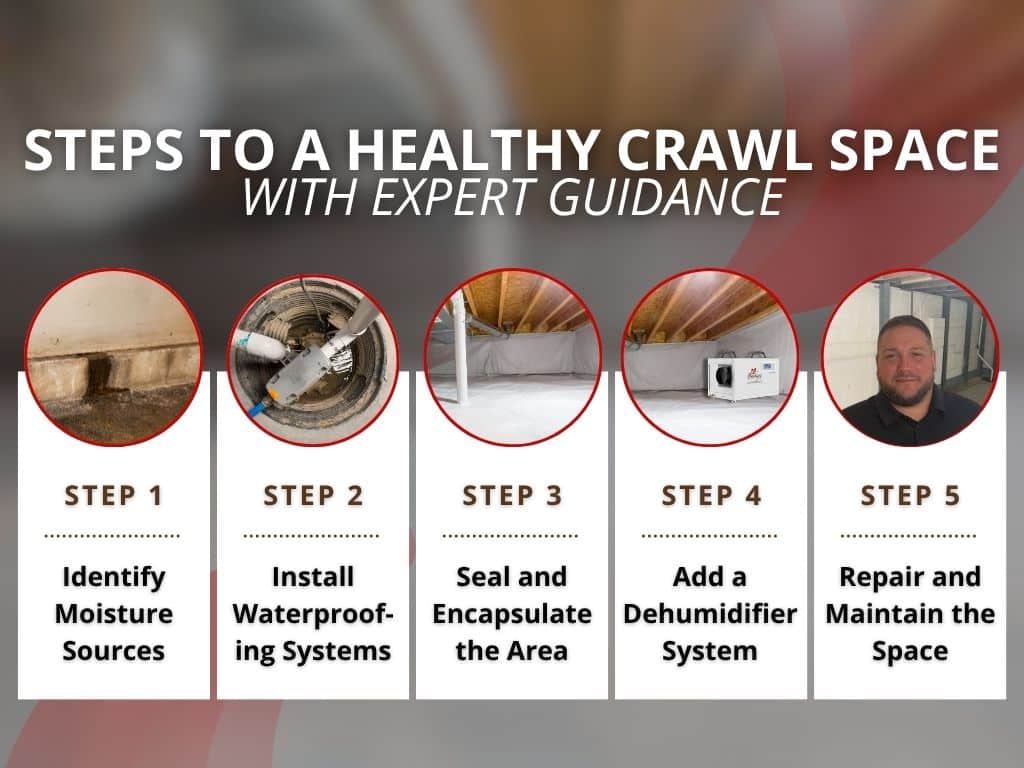
What Actually Removes the Smell
The order matters. Skip a step and the smell returns.
Step 1: Stop the Water
Fix grading, extend downspouts well away from the foundation, repair stem wall cracks, and address any plumbing or condensate leak. If groundwater collects under the house, that means interior drainage and often a sump pump. Nothing else works until the water stops.
Step 2: Cover the Ground
A ground vapor barrier cuts soil moisture at the source. There is a clear explanation of how a ground vapor barrier cuts soil moisture at the source if you want the mechanics.
Full crawl space encapsulation goes further: a 12-20 mil reinforced liner across the floor and up the walls and piers, seams sealed, vents sealed, and the access door sealed.
Step 3: Control the Humidity That Remains
A sealed crawl space still needs its humidity managed, which is what a dedicated dehumidifier does. Sizing rule of thumb: roughly 70 to 80 pints per day for about 1,000 square feet, and 130 to 200 pints for 1,100 to 2,000 square feet.
A household unit in a puddle-prone crawl space is not the same thing as a crawl space dehumidifier system, and we go into the difference in our post on how a crawl space dehumidifier protects your entire home.
Step 4: Remove What Is Already Damaged
Wet fiberglass insulation, moldy cardboard, and rotted wood all have to leave. Dead mold is still allergenic, so killing it is not enough. It has to be physically removed. Structural members that have lost strength need repair, not cleaning.
What Does Not Work
- Bleach on crawl space wood. It does not penetrate porous wood; it adds water to a space with a water problem, and the EPA does not recommend routine biocide use for mold cleanup. Never mix it with ammonia.
- Ozone generators and foggers. The EPA is clear that at concentrations that do not exceed public health standards, ozone has little effect in removing most indoor air contaminants and does not remove many odor-causing chemicals.
- Air fresheners and charcoal bags. These mask the odor for days while the wood keeps getting wetter.
- Mold testing before moisture testing. EPA guidance says sampling is usually unnecessary. If you can smell it, you have the finding. Measure the moisture and fix that.
- Opening the vents in July. Covered above. In an Ohio summer, this adds water.
Is a Musty Crawl Space Dangerous?
It is a health and structural risk rather than an emergency. Mold exposure commonly triggers allergy and asthma symptoms, and the stack effect means the affected air is circulating through the living space.
Sustained dampness also invites wood rot, insect activity, and rodents, and it ruins the insulation’s ability to do its job. What that earthy odor is telling you is worth understanding early, and there is a good plain-language breakdown of what that earthy odor is actually telling you.
The structural side is the part homeowners underestimate. Wood at 20 percent moisture content for a few seasons is wood losing strength, and sagging floors above a damp crawl space are common in Central Ohio.
What Crawl Space Encapsulation Costs
| Work | National range, 2026 cost guides |
|---|---|
| Ground vapor barrier only | $1,500 to $3,000 |
| Full encapsulation | $3 to $10 per square foot |
| Full system with dehumidifier and drainage | $5 to $12 per square foot |
| Dedicated crawl space dehumidifier | $1,500 to $3,000 installed |
| National average, full encapsulation | around $5,500 |
Related Questions to Explore
Why does my crawl space smell worse after rain?
Because humidity spikes and the soil under the house releases more moisture. Rain raises the outdoor dew point, saturates the ground, and often adds standing water. Mold activity increases within hours, and so does the odor. A smell that appears only after rain points to water entry rather than general humidity.
Can mold in a crawl space make you sick?
It can trigger allergy and asthma symptoms, coughing, congestion, throat irritation, and headaches, particularly in children and anyone with respiratory conditions. Because the stack effect draws crawl space air upward, the exposure is not limited to people who go under the house.
Should crawl space vents be open or closed in summer?
|Closed is generally better in Ohio, but only as part of a complete system. Sealing vents while leaving bare soil exposed traps moisture. Vents should be sealed together with a ground vapor barrier and a dehumidifier, which is the unvented path the code allows.
Can I use bleach to clean mold on crawl space wood?
No. Bleach does not penetrate porous wood; it introduces more water, and EPA guidance does not recommend biocides as routine practice. Removing the material and drying the space is the effective approach.
How long does it take for the smell to go away after encapsulation?
Usually a few days to a few weeks, depending on how much affected material was removed and how quickly humidity drops. If the odor persists past a month, something is still wet or something moldy is still in place. If you also smell it in the basement, our post on how to diagnose and get rid of a musty basement smell covers that separate set of causes.
When to Call a Professional
Some of this is homeowner work. Measuring humidity, clearing debris, extending downspouts, and sealing an obvious gap are all reasonable. Call someone when you hit any of the following.
- Standing water under the house, or water that returns after every rain.
- Crawl space humidity that stays above 60 percent after you have addressed the obvious sources.
- Visible growth across more than roughly 10 square feet of framing or subfloor.
- Sewage odor or a broken waste line. That is a health hazard and a plumbing job.
- Rodent droppings or urine. Do not disturb these without proper protection.
- Soft, spongy, or crumbling wood, or floors that flex above the crawl space.
- Sagging insulation hanging out of the joists.
We offer free inspections throughout the Greater Columbus area, including Dublin, Hilliard, Westerville, Powell, Worthington, Pickerington, and Zanesville.
A basement and crawl space inspection includes moisture readings, so you find out whether you are looking at a humidity problem or a water-entry problem before anyone quotes a system. We only suggest work that is needed.
Spring and early summer are the right time to schedule. Getting a system in before Ohio humidity peaks in July and August is far easier than chasing the smell in August.
Conclusion
- A musty crawl space smell is mold gas. If you can smell it, something under the house is wet enough to grow mold today.
- The numbers decide the outcome: relative humidity under 60 percent, wood moisture content under about 16 percent. Measure before you treat.
- Order of operations is water first, ground cover second, humidity control third, damaged material out last. Bleach, ozone, and air fresheners: skip all four.
If your house smells damp and you have not been under it lately, we can put a moisture meter on the framing and tell you what you are dealing with. Schedule your free estimate, and we will give you a straight answer about what your home actually needs.